ATLAS SIG Soundbite 1 – Cultural Tourism
In the ATLAS SIG Soundbites series the different ATLAS Special Interest Groups tell about their SIG.
Annual review of activities – 2026
Research activities
The ATLAS Cultural Tourism survey continues to gather data over 35 years after the first research was launched in 1991. This year we had a contribution from Cultural Management students at the Erasmus University Rotterdam, who collected data at a number of cultural sites spread across the city in November 2025.
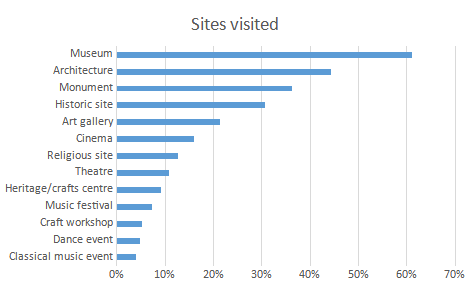
The 250 respondents were found predominantly at museums and monuments, the classic elements of the cultural tourism product. However, Rotterdam is also a city that profiles itself with modern architecture, which was also a prominent feature of cultural tourist consumption. Not surprisingly, events tended to be less frequently visited, and classical music was the least frequently consumed cultural experience.
The rising popularity of Rotterdam as a tourist destination was underlined by the fact that 56% of the respondents came from abroad. In common with most studies of cultural tourism, the visitors were found to be predominantly highly educated, with 42% having a first degree and 44% having a postgraduate qualification. As with previous ATLAS surveys, the cultural visitors tended to be relatively young, with almost 40% being between 20 and 29 years of age.
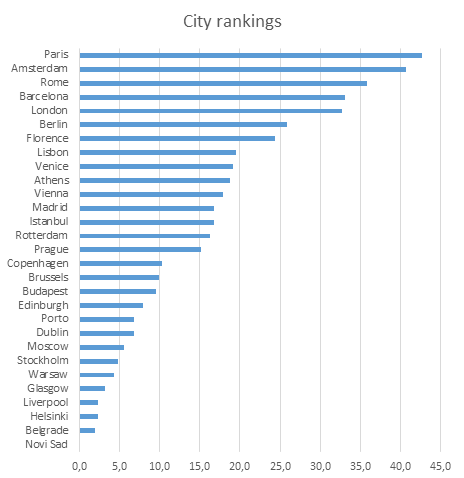
In common with previous surveys, visitors were asked to list their favourite cultural tourism cities. Paris, Amsterdam, Rome, Barcelona and London were all listed by over 30% of respondents, which largely matches the results of previous surveys. This indicates that smaller cities still find it hard to compete with places that already have a global reputation and large concentrations of cultural resources. Perhaps not surprisingly Rotterdam scored higher than in previous surveys because of the location of the research.
Publications
One of our longest-standing collaborators, Wil Munsters, produced a review of cultural tourism supply, concentrating on a review of cultural tourism typologies: Munsters, W. (2026). Cultural Tourism Supply: From Cultural Resources to Tourism Products. In Smith, M. (Ed.) Comprehensive Foundations of Tourism. https://doi.org/10.1016/B978-0-443-27698-9.00004-0. The abstract of this publication can be accessed on ResearchGate. This publication was edited by Melanie Smith, another long-time contributor to the ATLAS Cultural Tourism Project.
A special issue of the Journal of Tourism and Cultural Change on Intangible and digital heritage and cultural tourism is now nearing completion/completed. This collection of papers from the ATLAS conference in Breda was edited by Greg Richards and Maria del Pilar Leal Londoño. The issue will include an Editorial introduction and seven papers from the special tracks on Intangible Cultural Heritage and Tourism (organised with support from Crocus and contributions from Jessika Weber and Lénia Marques).
ATLAS recently helped to complete an extensive literature review on cultural and creative tourism in Europe for the Crocus Project. This has a strong focus on Intangible Cultural Heritage (ICH), and shows that ICH research has grown in rural areas in particular in recent years: Richards, G. et al. (2025). Cultural and Creative Tourism in Rural and Remote Areas: European perspectives. Tourism: An International Interdisciplinary Journal, 73(4), 771 – 798. https://doi.org/10.37741/t.73.4.12
A further analysis on ICH and rural cultural tourism has also been published in an open access book edited by Adina Letiția Negrușa and Monica Maria Coroş of Babeș-Bolyai University in Cluj-Napoca, Romania on Innovation, Sustainability, and Growth in a VUCA Environment: https://link.springer.com/chapter/10.1007/978-3-032-11639-0_10
Plans for 2026 and further
At the ATLAS Annual Conference in Leeds in 2026 we will be organising a Special Track on “Shaping places through cultural and creative tourism” in conjunction with the Crocus Horizon Project (Cross-border Cultural and Creative Tourism in Rural and Remote Areas). This track will reflect on the placemaking and placeshaping role of cultural and creative tourism, reflecting the shift towards more holistic, place-based approaches to tourism development. This session will also provide the basis for a special issue of the Journal of Policy Research in Tourism, Leisure and Events.