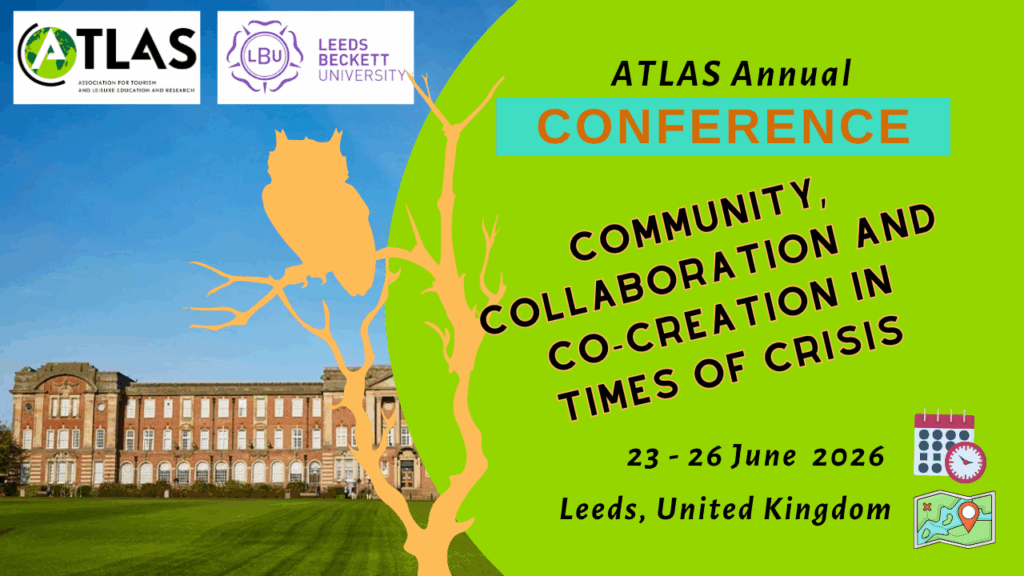
ATLAS Annual Conference 2026
Community, Collaboration and Co-creation in Times of Crisis
Leeds, United Kingdom
June 23-26, 2026
Special Track 1 – Regenerative Tourism
Special Track 2 – From Dissonance to Design: Ethics, Evidence, and Care across Dark & Heritage Sites
Special Track 3 – Systems Thinking for Collaborative Tourism Governance in Times of Crisis
Special Track 4 – Volunteer Tourism and Space Place Mobilities in Tourism
Special Track 5 – Platformisation of tourism and hospitality work and impact on worker well-being: The role of social dialogue
Special Track 6 – Co-Creating Acts of Community Resistance in Tourism Destinations in times of Crisis
Special Track 7 – Showing What Words Can’t: A Visual Un-Conference Track on Tourism, Community and Collaborative Ways of Seeing
Special Track 8 – Children’s voices in tourism
Special Track 9 – Loved, unloved or overlooked: Animals in tourism
Special Track 11 – Beyond Recovery: Ethical, Social and Educational Responses to Tourism Crises
Special Track 12 – Shaping places through cultural and creative tourism
Special Track 13 – Transitions and transformations in Urban Tourism
Special Track 14 – Beyond Growth: Degrowth and Post-growth Perspectives in F&LEs
Special Track 15 – Artificial Intelligence: Impacts on the Tourism Sector – What are we doing as Practitioners – what are we doing as Educators?
The deadline for submitting abstracts has been extended to February 15th 2026
Introduction
Community, Collaboration and Co-creation in Times of Crisis
We live in a time of multiple, intersecting crises that are shaping new ways of engaging with and experiencing tourism. These crises include growing inequalities, threats to democracies, social fragmentation, the rise of populism and nationalism, forced displacement, climate change, global oligarchies, the increasing power of technocracy, wars, and pandemics. These changes and challenges not only refine the meaning of communities but also influence how collaborative and participatory patterns emerge and evolve among tourism stakeholders.
In traditional anthropology and sociology, the concept of communities has often been framed in unproblematic terms (Jørgensen, 2024). However, recent global geo-political, ecological and economic shifts have contributed to a more critical examination of this concept. Communities are typically defined as groups that share a common geographical or physical space (Urry, 2001) but also belong to the same social group. In discussing the local turn in tourism, Higgins-Desbiolles and Bigby (2022, p.2) define local communities as “more than just a certain group of people associated with a place. Instead, we are more broadly inclusive of the local community, the local ecology (living air, land and waterscapes and more-than-human beings) and all generations pertaining to that place (including future ones)”.
The concept is further problematised in relation to growing divisions, polarised identities and ideologies, global misinformation (via the web, for example) and human/non-human exploitation. In acknowledging the contradictions, ‘fractures and disenchantments’ of our time (Braidotti, 2019, p.36), Rosi Braidotti calls for closer scrutiny on the meaning and entanglements of ‘we’ (p.37). This invites a critical reconsideration of how our shared condition shapes understandings of who ‘we’ are and to what extent, we can argue, we are in this together.
The possibilities and potentials of our collective praxis and aspirations to navigate, through transformation and resistance, fractures and ‘irreconcilable power differences’ (Braidotti, 2019, p.43), allow us to consider the heterogeneity and diversity of relational subjects (both human and non-human) and approaches. Accordingly, Braidotti (2019, p.157) argues that “we-are-in-this-together-but-we-are-not-one-of-the-same” (italics in the original). This highlights that our heterogeneity is defined by social categories such as class, race, sexual orientation, able-bodiedness but also by power, norms, values, privileges, rights, entitlements (Braidotti, 2019). The multiplicity of relational, heterogeneous subjects forms communities that must act together to reclaim power, agency and freedom.
Within the leisure context of tourism and events, we focus on the affirmative possibilities that community participation can forge through collaboration, driven by the shared aspiration of empowerment, fairness and inclusion. However, this is not without challenges, as communities’ involvement, participation and co-production are often hindered by the “structural injustices under which tourism operates” (Higgins-Desbiolles, 2020, p.616). Localising (Freya Higgins-Desbiolles and Bigby, 2022) and socialising tourism (Higgins-Desbiolles, 2020) may open possibilities for greater justice and well-being for local communities and, more broadly, for all tourism stakeholders.
For this conference, we invite contributions from a wide range of multi-, intra- and transdisciplinary fields on ways community participatory and collaborative approaches unfold in tourism destinations. We encourage critical debates on innovative and creative theoretical, methodological and practical community approaches to collaboration and co-creation within the fields of events, tourism and hospitality. Furthermore, we seek thought-provoking insights into the factors that might hinder such approaches. In reflecting on how, if and to what extent collaboration and co-creation develop in tourism contexts, we pose the following questions:
How do power structures influence collaboration and co-creation in tourism destinations?
What power dynamics influence collaborative approaches to tourism?
How do collaboration and co-creation unfold in a time of multiple, intersecting crises? Which crises are the most influential, and how can they be overcome through community involvement and collaboration?
How do communities respond locally to global changes and challenges?
To what extent are grassroots movements and approaches influential in shaping co-creation of types of tourism that benefit destinations and communities? Have these evolved over time and in response to the multiple crises experienced globally?
What are the enablers and barriers to developing collaboration and co-creation within the tourism sector between Western and Indigenous approaches?
How do collaborative approaches develop over a human/non-human continuum?
References
Braidotti, R. (2019). Posthuman knowledge (Vol. 2). Cambridge: Polity Press.
Jørgensen, M. T., Sundbo, J., & Fuglsang, L. (2024). Co-creating communities of place in second home tourism. Scandinavian Journal of Hospitality and Tourism, 24(2), 153-172.
Higgins-Desbiolles, F. (2021). Socialising tourism for social and ecological justice after COVID-19. In Global tourism and COVID-19 (pp. 156-169). Routledge.
Higgins-Desbiolles, F., & Bigby, B. C. Embracing the Local Turn in Tourism to Empower Communities.
Higgins-Desbiolles, F. and Bigby, B.C. (2022) A local turn in tourism studies. Annals of Tourism Research 92, 103291. https://doi.org/10.1016/j.annals.2021.103291.
Urry, J. (2001). The sociology of space and place. The Blackwell companion to sociology, 1(1), 3-15.
Keynote speakers
Anna De Jong

Anna de Jong is a Professor of Tourism and Regional Development at the University of Glasgow. Anna is an interdisciplinary social scientist, with a background in human geography, tourism management and philosophy. Her current research takes focus with tourism governance in regional areas, guided by wider concerns of resident inequalities, political capacities and participatory governance.
Sandro Carnicelli

Sandro Carnicelli is a Professor of Tourism and Leisure Studies at the University of the West of Scotland and the Deputy Director of the Centre for Culture, Sport, and Events (CCSE). Sandro is a member of ABRATUR (International Academy for the Development of Tourism Research in Brazil) and the current chair of the Renfrewshire Council Tourism Leadership Group. Previously, he was the Treasurer of the Leisure Studies Association and a member of the Executive Board of ABPCO (Association of British Professional Conference Organisers).
As a researcher, Sandro has been working in the fields of Tourism, Events, and Leisure for 20 years. Sandro has now over 50 publications between book chapters and peer-reviewed papers. Sandro has co-edited three books: Digital Leisure Cultures (2014); Lifestyle Sports and Public Policy (2014); and Tourism Cases in Latin America (2025). He has delivered funded projects for organisations such as the Carnegie Trust, UK Department of Transport, the Moffat Trust, The Higher Education Academy, and the UKRI-GCRF. He currently serves on the Editorial Board of Leisure Studies Journal, and the Journal of Adventure Education and Outdoor Learning. He acts as an Associate Editor for Event Management Journal, and he is currently the Editor in-Chief of the World Leisure Journal.
Raoul Bianchi

Raoul Bianchi is Reader in Political Economy in the Faculty of Business & Law at Manchester Metropolitan University. Following ethnographic field research on different aspects of tourism development and cultural heritage in the Canary Islands in the 1990s, over the past two decades his work pivoted towards theoretical scrutiny of the international political economy of tourism and related themes, including, dynamics of tourism and capitalism; tourism geopolitics and citizenship; tourism, work and labour relations and more recently, questions related to the political economy of crisis and postgrowth visitor economies. His primary empirical focus remains Spain, southern Europe and the wider Mediterranean region, which has led to long and fruitful collaborations with the Universities of Las Palmas de Gran Canaria, Barcelona, the Balearic Islands and others in the region, as well as the independent research think-tank, Alba Sud. Raoul was for several years a visiting lecturer at Wageningen University and Research and is currently an Associate Editor at Annals of Tourism Research and editorial board member of Tourism Planning and Development and the Journal of Balkan and Near Eastern Studies. Raoul has also been closely involved in campaigns for tourism and socioecological justice and was previously a member of the executive council of former UK NGO, Tourism Concern.
Conference Sub-Themes
The main theme of the conference is:
Community, Collaboration and Co-creation in Times of Crisis
In the context of tourism destinations navigating complex crises, turbulence and uncertainty we welcome abstracts in the following areas:
- Power and Participation in Tourism – Exploring how social, political, and institutional hierarchies shape collaboration and co-creation in destinations, particularly during periods of instability.
- Collaborative and Systemic Pathways in times of (Poly)crisis – Exploring how collaboration and systemic co-creation foster resilient communities and destinations amid the uncertainty of multiple intersecting crises.
- Grassroots Innovation and Community-Led Tourism – Highlighting the impact of bottom-up initiatives on co-created tourism practices that address evolving local needs and complex disruptions.
- Indigenous and Non-Indigenous Approaches to Co-creation– Fostering inclusive, culturally sensitive, and respectful collaboration in tourism, particularly during times of social or environmental turbulence.
- Rethinking Co-Creation in Tourism – Advancing innovative theories, methods, and practical approaches to enhance participatory practices.
- Human and Non-Human Collaboration – Integrating environmental systems, non-human actors, and ethical considerations into tourism co-creation.
- Barriers and Breakthroughs in Participatory Tourism – Examining challenges, approaches and strategies that shape successful collaborative initiatives under turbulent contexts.
- Local Adaptation to Global Change – Investigating how communities and destinations transform tourism practices through participatory, systemic and co-creative approaches.
- Creative Co-Created Experiences – Showcasing innovation, engagement, and imaginative collaboration in events, tourism, outdoor recreation, and hospitality under disruption.
- Inclusive Tourism Futures – Envisioning resilient, equitable and community-empowering collaborative practices in tourism destinations in times of uncertainty.
PhD Seminar
ATLAS PhD Seminar
Publishing tourism research: Community, Collaboration and Co-creation in Times of Crisis
Tuesday June 23rd, 2026
The ATLAS conference this year focuses on the importance of tourism (including leisure, hospitality and events) research in times of uncertainty and turbulence. In this unpredictable environment, shaped by multiple, intersecting crises, tourism may offer many opportunities for hope and collaboration, for challenging distrust and confusion, and opening up possibilities for greater justice. Of course, tourism is not immune to wider workings of power that can divide and exclude, and the conference will also consider how tourism can reflect and contribute to practices and discourses that marginalise some groups and communities, exacerbating divisions and separating people from each other and the nonhuman world around us. In these challenging times, how can collaboration and co-creation develop in tourism contexts to foster communities that can act together to reclaim agency and freedom, and a more hopeful and equitable future for all? It is within these discussions that the PhD seminar is situated.
More information on the ATLAS PhD Seminar can be found HERE
Call for Special Tracks
The conference organizers invite proposals for organizing special tracks during the conference and encourage ATLAS Special Interest Groups and Chapters to plan meetings and workshops within or alongside the conference programme. Please contact admin@atlas-euro.org before December 15th 2025 if you have any plans to organize a Special Track, SIG meeting or a project meeting during this conference.
Special Track 1
Regenerative Tourism
Special Track Convenors
Sanna-Mari Renfors – Lapland University of Applied Sciences, Finland
Aisling Ward – Munster Technological University, Ireland
A shift from sustainability to the regenerative paradigm is needed to increase the social and ecological wellbeing of the tourism place. In regenerative tourism, tourism is seen as a living system, it is developed from the unique potential of place and embraces the ecological worldview. Tourism is about enhancing the mutually beneficial, complex and co-evolving relationship between people and their place, humans and natural systems with a bottom-up approach.
This Special Track aims to foster a comprehensive forum for exploring how the regenerative mindset and the principles of regenerative development can be applied to tourism. It welcomes contributions related to increasing the regenerative capacity and wellbeing of natural and human living systems in the tourism context.
The track invites researchers to discuss regenerative tourism as a concept and its practical considerations in action. In line with the theme of the ATLAS 2026 conference, the track fosters dialogue about collaborative and community participatory approaches in regenerative tourism.
Therefore, this session welcomes submissions on topics including, but not limited to:
• Theoretical perspectives of regenerative tourism – concepts and principles
• Tourism entrepreneurs and SMEs as change agents: regenerative business models, practices and products
• Place literacy, place-sourced and indigenous knowledge, storytelling
• Environmental regeneration: regeneration of land, soil, water bodies, forests through tourism
• Social and cultural regeneration: empowering local communities, revitalising cultural heritage through tourism
• Economic diversification and resilience, revenue strategies
• Open collaboration and community participatory approaches
• Guest engagement: encouraging guests to become active participants in regeneration
• Measuring regenerative impact
• Policy integration and regenerative destination planning: aligning regenerative goals with public policies and destination strategies
Special Track 2
From Dissonance to Design: Ethics, Evidence, and Care across Dark & Heritage Sites
SIG Dark Tourism
SIG Heritage Tourism and Education
Special Track convenors
Konstantina Zerva, University of Girona, Spain
Adrian Guachalla Gutierrez, London Metropolitan University, United Kingdom
Gai Jorayev – Macao University of Tourism, China
This special track, jointly organised by two ATLAS Special Interest Groups, ‘Dark Tourism’ and ‘Heritage Tourism and Education’, invites contributions which showcase conceptual, methodological and empirical advances to understand the relation between heritage, tourism and dark times.
In recent years, tourism has increasingly expanded into sites and situations marked by conflict, injustice, trauma, environmental devastation and other forms of “dissonant” heritage. At the same time, educators, curators, guides and communities are experimenting with new ways of designing visitor experiences that invite critical reflection, responsibility and forms of care. This joint special track aims to explore how ethically grounded and pedagogically informed “design” can respond to the tensions, power relations and emotional demands that characterise dark and dissonant heritage.
The track invites contributions that interrogate how such sites are curated, narrated, governed, consumed and taught: from former prisons, battlefields and memorials, to sites of colonial violence, border regimes, forced displacement, socio-environmental disasters, or everyday urban marginality. We are particularly interested in how visitors’ motivations, emotions and media practices intersect with institutional strategies, community perspectives and educational interventions; and in how collaboration and co-creation can move tourism beyond voyeurism towards solidarity, recognition and repair.
We welcome conceptual, empirical, methodological and practice-based papers, as well as reflexive accounts from practitioners and educators. We invite submissions that may address, but are not be limited to, the below-mentioned areas:
• Co-creating experiences at dark tourism heritage sites – ‘voiceless’ communities in shaping the tourism product, narrative and representation;
• Ruptures in dark heritage tourism – from contestation to collaboration
• Planning for resilient dark heritage tourism
• Ethics, emotions and care in dark & dissonant heritage tourism
• Pedagogies of difficult pasts and troubling presents
• Guided Tours, Embodied Itineraries and On-Site Storytelling
• Decolonising Narratives at Dark & Heritage Sites
• Immersive Technologies and Experiential Simulations of Trauma and Conflict
• Consent, voice and vulnerability when working with affected communities in the co-creation, curation and communication of dark and dissonant heritage.
This special track aims to foster dialogue between scholars and practitioners working on dark tourism, heritage, and tourism education, and to collectively explore how more ethical, evidence-based and caring forms of design can contribute to community, collaboration and co-creation in times of crisis.
Special Track 3
Systems Thinking for Collaborative Tourism Governance in Times of Crisis
SIG Systems Thinking
Special Track Convenors
Kyriaki Glyptou – Leeds Beckett University, United Kingdom
Rodolfo Baggio – Bocconi University, Italy
Tourism today unfolds within a landscape of overlapping crises that reshape destination relationships, challenge existing power structures and expose deep systemic vulnerabilities across tourism destinations and their governance frameworks. In such turbulent and uncertain times, new realisations emerge, prompting critical questions about who “we” are as interconnected stakeholders crucially embedded within communities, and how our actions—and those of others—ripple across our shared futures.
This is precisely where Systems Thinking offers a necessary shift in mindset. Rather than viewing the impact of crises in isolation, a systemic perspective reveals how shocks reverberate across communities, institutions, governance structures and ecosystems, bringing into focus the feedback loops, dependencies and leverage points that traditional governance approaches often overlook. Crises reveal the limitations of reductionist governance where decisions are taken isolation from the social, cultural, economic and ecological relationships that bind communities and destinations together.
Within this broader systems view, collaboration becomes not merely a participatory aspiration but a vital mechanism for system-wide transformation in crisis governance and decision-making. Systems Thinking reveals how governance choices cascade across social and ecological scales, how policies both influence and reflect community resilience and vulnerability, and how crises expose hidden interdependencies and systemic inequities. It further highlights collaboration and co-creation as powerful leverage points for structural transformation. Integrating Systems Thinking into tourism governance and policy enables actors to anticipate unintended consequences, build long-term resilience and co-design strategies grounded in community priorities.
This Special Track positions Systems Thinking as a crucial foundation for effective crisis governance and invites conceptual, methodological and empirical contributions that demonstrate how systemic approaches can transform tourism governance, policy development and impact assessment in times of crisis, strengthening the overall resilience of tourism destinations and their communities. We invite submissions that address, but are not limited to, the following themes:
1. Systems Thinking in Governance and Policy
• Governance frameworks that integrate complexity, feedback loops and long-term impacts
• How governance choices cascade across social and ecological scales
• Systems-based assessment of policy responses and their effects on community resilience
2. Crisis, Vulnerability and System Dynamics
• How crises expose system weaknesses, inequities and hidden interdependencies
• Systems mapping of vulnerabilities, cascading effects and adaptive capacities
• Long-term, transformative approaches to crisis response beyond short-term fixes
3. Systems Thinking for Power Shifts and Regenerative Futures
• Collaboration and co-creation as leverage points for structural change and power redistribution
• Systems-based approaches that foreground justice and equity in crisis governance and long-term transformation
• Co-creating solutions informed by diverse knowledges and worldviews and participatory practices.
4. Applied and Empirical Insights
• Case studies of systemic change and adaptive transitions in tourism during or after crises
• Empirical insights into complexity, interdependence and multi-scalar governance within the tourism system
• Participatory decision-making models that strengthen system resilience and support adaptive, community-centred governance
The Track will host a participatory workshop using soft systems thinking and causal loop modelling to explore a tourism crisis scenario, identify key feedback loops and reveal potential leverage points for transformative action.
Special Track 4
SIG Volunteer Tourism
SIG Space Place Mobilities in Tourism
Special Track Convenors
Elisa Burrai – Leeds Beckett University, United Kingdom
Davide Sterchele – Leeds Beckett University, United Kingdom
Antonio Paolo Russo – Rovira i Virgili University, Spain
Isabel Paulino Valldepérez – Rovira i Virgili University, Spain
In this joint special track, we explore the intersections between mobilities, volunteering, aid, and (international) development in times of crisis with a focus on the spatial and mobile dimensions of volunteering practices. This session aims to stimulate critical discussion on how multiple and overlapping crises, including growing inequalities, threats to democracy, social fragmentation, populism and nationalism, forced displacement, climate change, the rise of technocracy, wars, and pandemics, shape and transform contemporary geographies of mobility and the productions of place through volunteering.
Following Laurie and Baillie Smith (2018), and the broader call to think “biopolitically” of tourism mobilities (Sheller, 2015), we seek to challenge “fixed understandings of agency and experiences” in established volunteering scholarship. In recent decades, volunteer tourism and transnational mobility — often from the Global North to the Global South — have been interrogated for reproducing unequal power relations, white saviourism, dependency, and neo-colonial imaginaries. Yet these practices are always spatially grounded and mobile: they involve movements through specific infrastructures, affective landscapes, and territorial imaginaries that construct both volunteers and host communities in particular ways (Trifan & Dolezal, 2024).
Echoing Baillie Smith, Thomas & Hazeldine (2021), we encourage closer scrutiny of how volunteering experiences move, circulate, and evolve in today’s unsettled global context. This track explores the temporalities and spatialities of volunteering, questioning universalist understandings of (international) volunteering: how places of volunteering are made and remade, how borders, infrastructures, and technologies mediate access and belonging, and how changing mobility regimes reshape ideas of care, solidarity, and moral responsibility (Di Matteo, 2024).
In a world of shifting geopolitics, forced migration, climate emergencies, conflict, and rising populist nationalism, concepts such as care, solidarity, altruism, ethics, and morality may acquire new context-specific meanings across spatial and moral geographies (Burrai and Sterchele, 2025). The deep and fast-paced socio-ecological, political, economic, and technological transformations of our time invite consideration of new forms of (im)mobile volunteering, including bottom-up and grassroots initiatives with potential for systemic change. In light of these considerations, we ask:
• How do crises reshape the spatial organisation of volunteering and the infrastructures of mobility that sustain it?
• How will mobility flows and trajectories be shaped by climate change, inequality, democracy crises, digital surveillance, and global economic shifts?
• Who will be able, or permitted, or take new interest to travel and volunteer in the future, and why?
• How do places of volunteering (villages, urban spaces, borderlands, online communities) become arenas for negotiating belonging, ethics, and power?
• Will economic and political pressures erode the Global North’s middle-class foundation of volunteer tourism, or trigger new South–North and intra-regional mobilities?
We invite conceptual, empirical, and methodological contributions that address these questions and critically examine the future of volunteer tourism and mobilities. Submissions may engage with themes such as:
• Changing spatial and power relations in volunteering mobilities;
• Ethics, care, and solidarity in situated contexts of crisis;
• Digital and virtual volunteering (im)mobilities and their spatial politics;
• The impact of surveillance, borders, and mobility restrictions;
• Postcolonial and feminist approaches to volunteering spaces and movements;
• Grassroots, place-based and locally driven forms of volunteering;
• Affective geographies and the making of “spaces of care” and “places of solidarity.”
Our aim is to map and debate possible futures: from fairer, more inclusive, and environmentally sustainable volunteer tourism to a more fragmented world where mobility is increasingly controlled, surveilled, and unequally distributed.
Finally, we will explore opportunities for publishing a collection of fully developed papers in a special issue in a relevant and high-impact journal in our field.
References
Baillie Smith, M., Thomas, N., & Hazeldine, S. (2021). Rethinking volunteering and cosmopolitanism: Beyond individual mobilities and personal transformations. Geopolitics, 26(5), 1353-1375.
Burrai, E., & Sterchele, D. (2025). Towards posthuman geographies of volunteer tourism in a time of polycrisis. Tourism Geographies, 27(3-4), 666-676.
Di Matteo, G. (2023). Resistance or exclusion? The paradoxes of volunteer tourism, migration, and memorialization nexuses. Tourism Geographies, 25(7), 1746-1762.
Laurie, N., & Baillie Smith, M. (2018). Unsettling geographies of volunteering and development. Transactions of the institute of British geographers, 43(1), 95-109.
Sheller, M. (2016). Uneven Mobility Futures: A Foucauldian Approach. Mobilities, 11(1), 15-31.
Trifan, C. A., & Dolezal, C. (2024). Digital voluntourism and sense of place: volunteers’ responsibility towards an ‘imaginary locality’. Tourism Geographies, 26(8), 1293-1312.
Special Track 5
Platformisation of tourism and hospitality work and impact on worker well-being: The role of social dialogue
Special Track Convenors
Fiona Bakas – University of Lisbon, Portugal
Michela Trentin – University of Westminster, United Kingdom
Stroma Cole – University of Westminster, United Kingdom
Tara Duncan – Dalarna University, Sweden/Thomspon Rivers University, Canada
Kavita Ashton – Equality in Tourism, United Kingdom
The Tourism and Hospitality (T&H) sector is increasingly utilising sharing economy platforms. The sector is already well known for its labour intensity and high participation rates of young people, women, and migrant workers who often lack opportunities and voice, have poor working conditions (including seasonality and unsocial hours), high rates of precarious/non-standard employment and low rates of unionization (Giousmpasoglou, 2024). Disadvantaged people, including women, are arguably more vulnerable in this new work environment and the European Institute for Gender Equality (EIGE, 2022) warns that whilst sharing platforms can contribute to more gender equality, they can also reinforce sexism and inequality.
The Digital Revolution, as a wave of innovation, is leading to the growth of some sectors of activity and jobs within them, and the reduction or disappearance of other (now old) sectors and jobs. Digitalization in the T&H sector can also be seen to play ‘a critical role in mobilizing workers social differences’ (Alberti & Iannuzzi, 2020, p. 2), transforming labour dynamics and creating opportunities and challenges for workers, particularly in the context of sharing economy platforms. Worker well-being is central to digitisation, but there is a “conceptual jungle that currently characterizes the employee wellbeing literature” (Mäkikangas et al. 2016, p. 62). Hence worker well-being is defined here as the capacity to live the lives individuals value, supported through health, financial security, work–life balance and social inclusion (ILO, n.d.; OECD, 2022), and includes having dignity, autonomy, authenticity and purpose (Mellors & Gaspar, 2025).
Platform work more generally, is seen by some as just ‘piece-work dressed up with a fancy technology’ (Dubal, 2020), but more and more people are relying on platforms for their full-time employment, rather than just supplementing their income as has been the case in the recent past (Cansoy & Schor, 2023). For workers who earn all their income from platform work, platform work is not a “gig,” but an all-consuming job with long hours, often depending on two or more platforms for livelihood.
Focusing on the impact of plaformisation on worker well-being in particular, T&H sharing platforms are defined here as companies that: 1) recruit T&H workers to work in hotels, restaurants, and events; 2) connect service providers with customers; and 3) conduct surveillance (algorithmic management and biometric control) of T&H workers whilst they are working. Despite the infiltration of digitisation within many T&H workers’ lives, for example as seen in how gender-based harassment emerges in this type of T&H platform work as the type of relationships between client and service provider (or tourist-host) is changing in the new platform work context (Bakas & Salman, 2024), very limited research exists on the impact of the rapidly technologically advancing phenomenon from a workers´ perspective (Iranmanesh et al., 2022). So how does the rise of these sharing platforms—e.g., Constellations, Coople as recruitment platforms, FairBnB as a service-provider network and algorithmic management systems—impact the workforce’s well-being and quality of life?
The future structure of employment, whether upgrading, polarization or something else, has important implications for the future of work and social dialogue. Social dialogue, which can be defined as the iinvolvement of social partners in policymaking, has started to be implemented in the tourism industry in the EU relatively recently (Dresin, 2019). However, despite the EU’s sustained efforts to promote social dialogue, it only provides minimal legal provision for its effective enforcement (Guisset, Lenaerts & Vangeel, 2025). During the COVID pandemic there was an increased realisation that collaboration between the state, industry, social partners and workers was essential to stabilise the tourism sector and lead the path of sustainable recovery. If social dialogue is an important form of collaboration and has the potential to improve workers well-being, which is essential for more resilient and human well-being centred tourism development models, more research on this topic is required to progress knowledge and ensure theory can become a reality.
We welcome critical, engaged empirical research presentations as part of this paper session. Topics for consideration might include, but are not limited to:
• Is there a well-being crisis in T&H work?
• How platformisation of the T&H sector leads to both positive and negative impacts on workers’ well-being
• Case studies of how T&H platforms influence vulnerable T&H workers
• Ways in which algorithmic surveillance in T&H work relates to precarious working conditions
• How tripartite (workers-industry-trade unions) social dialogue operates in the T&H industry
• What barriers or opportunities for collaboration are there for social dialogue in T&H?
• How T&H platforms act as mediators, attracting and selecting self-employed platform workers, how they reconfigure the roles and responsibilities of human resource management, and what is their impact on worker’s experiences
• What the implications are of platformisation at the intersections with other stakeholder groups (apart from workers) such as the destination, local community or tourists
• A focus on gendered, intersectional perspectives and how these may impact well-being, social dialogue and platformisation.
The second part of this call will be for a workshop session which will build on the collection of papers presented in session(s) above. It will also utilise the impetus of the FUTOURWORK project (see www.futourwork.eu) to bring together scholars and other interested parties to discuss how our research, outputs and dissemination can be utilised to make a difference, specifically in relations to intersectionality, social dialogue and well-being in light of the platformisation of T&H. Employing multi-stakeholder engagement in our dissemination processes, this workshop will involve group activities, lively discussion and scenario planning to work towards tangible ways forward for students, academics, workers and industry stakeholders to engage, promote and ensure well-being in the T&H sectors.
Acknowledgements
FUTOURWORK is a Horizon Europe project, funded by the European Union under grant number 101178573.
References
Alberti G. & Iannuzzi, F. E. (2020). Embodied intersectionality and the intersectional management of hotel labour: The everyday experiences of social differentiation in customer-oriented work. Gender Work Organisation, 27, 1165–1180. https://doi.org/10.1111/gwao.12454
Bakas, F.E. & Salman, D. (2024). ‘’You ensure your own safety’: Gender and tourism labour in the gig economy’. Gender, Place and Culture. 31(8), 1072-1094, https://doi.org/10.1080/0966369X.2024.2327999
Cansoy, M., & Schor, J. (2023). Commercialization on “Sharing Platforms”: The Case of Airbnb Hosting. American Behavioral Scientist, 68(8), 983-1006. https://doi.org/10.1177/00027642231155366 (Original work published 2024)
Dubal, V. B. (2020). The time politics of home-based digital piecework. Centre for Ethics Journal, 2020, 50.
Dresin, E. (2019). Social Dialogue in the European Hotel and Restaurant Sector-EFFAT-HOTREC Work Programme 2020-2021 Issues Methodology Output.
EIGE. (2022). “Artificial Intelligence, Platform Work and Gender Equality”.
https://eige.europa. eu/publications/artificial-intelligence-platform-work-and-gender-equality
Giousmpasoglou, C. (2024). Working Conditions in the Hospitality Industry: The Case for a Fair and Decent Work Agenda. Sustainability, 16(19),8428. https://doi.org/10.3390/su16198428
Guisset, A., Lenaerts, K., & Vangeel, N. (2025). How the EU shapes National Social Dialogue: A Qualitative analysis of social partners’ Involvement in the Recovery and Resilience Plans and Territorial Just Transition Plans. Shaker Verlag GmbH.
ILO. (n.d.) Decent work. https://www.ilo.org/topics/decent-work
Iranmanesh, M., Ghobakhloo, M., Nilashi, M., Tseng, M. L., Yadegaridehkordi, E., & Leung, N. (2022). Applications of disruptive digital technologies in hotel industry: A systematic review. International Journal of Hospitality Management, 107, 103304.
OECD. (2022). Promoting health and well-being at work: Policy and practices. OECD Publishing. https://doi.org/10.1787/e179b2a5-en
Mäkikangas, A., Kinnunen, U., Feldt, T., & Schaufeli, W. (2016). The longitudinal development of employee well-being: A systematic review. Work & stress, 30(1), 46-70.
Mellors, J. & Gaspar, T. (2025). Keeping it real? Authenticity and well-being at work. Annals of Tourism Research, 114, 104012. https://doi.org/10.1016/j.annals.2025.104012
Special Track 6
Co-Creating Acts of Community Resistance in Tourism Destinations in times of Crisis
SIG Systems Thinking
SIG Visual Tourism
Special Track Convenors
Kyriaki Glyptou – Leeds Beckett University, United Kingdom
Nick Mai – University of Leicester, United Kingdom
Nika Balomenou – Swansea University, United Kingdom
Communities within tourism destinations face mounting challenges in the contemporary turbulent and uncertain era. Climate change endangers ecosystems and livelihoods; political instability and conflict fracture social cohesion; widening economic precarity deepens social inequalities; and global market volatility amplifies social, economic and economic risks and threatens stability and collective resilience. This polycrisis exposes structural injustices that often marginalize local community voices while privileging dominant interests, creating asymmetrical power relations that constrain participation in decision-making.
Amid these pressures, communities can be both passive recipients of external forces and active agents who engage in active or passive acts of resistance. Resistance takes many forms—ranging from grassroots mobilization and indigenous-led initiatives to everyday practices of resilience, cultural and natural resources preservation and identity affirmation. Yet these acts rarely emerge in isolation. They are co-created through formal and informal collaboration and interaction among diverse actors—local residents, social movements, civil society groups, tourism practitioners, researchers, filmmakers, and even non-human agents such as ecosystems and heritage landscapes—that collectively reimagine and reshape tourism futures.
Co-creating acts of resistance requires acknowledging complexity, embracing plural perspectives, and mobilizing collective capacities. It involves building solidarities across differences, experimenting with innovative practices, and identifying leverage points within systems where small actions can generate significant change. Through such collaborative resistance, communities engage affectively and collectively with their environment in ways that can allow them to reclaim agency, transform tourism from a source of vulnerability into a platform for empowerment, and open pathways towards more just, inclusive, and sustainable futures.
This track explores how communities, in times of turbulence and uncertainty, develop innovative ways to navigate structural constraints and power asymmetries, re-affirming or re-inventing their values, aspirations, and identities while co-creating tourism experiences that strengthen resilience.
We invite contributions that critically examine collaborative, participatory, and co-creative practices as forms of resistance, empowerment, and justice in tourism, hospitality and event contexts.
Indicative Themes
• Tourism in the Polycrisis: Collaborative responses to climate change, economic precarity, political instability, and global market volatility
• Acts of Resistance: Grassroots, Indigenous-led, and everyday community practices aiming to preserve culture, identity, and ecosystems
• Power and Participation: Unpacking asymmetrical power relations and structural injustices in tourism governance and decision-making
• Collaborative Futures: Co-creation and co-production among residents, civil society, social movements, tourism authorities and tourism private sector
• Human and More-than-Human Communities: Exploring the role of ecosystems, heritage landscapes, and non-human actors in shaping tourism resistance
• Localising and Socialising Tourism: Pathways for justice, well-being, and inclusive development in destinations
• Solidarity in Diversity: Building alliances across class, race, gender, ability, and cultural difference in tourism contexts
• Innovation and Leverage Points: Experimental practices and systemic interventions that foster empowerment and transformation
• Tourism as a Platform for Empowerment: From vulnerability to agency in times of turbulence and uncertainty
• Methodological Innovations: Research approaches for capturing collaboration, resistance, and resilience in tourism, hospitality, and events
• Visual and Affective Methods: Participatory filmmaking, photographic inquiry, collaborative visual ethnography, and affect-based approaches for exploring resistance, resilience, and community agency
Special Track 7
Showing What Words Can’t: A Visual Un-Conference Track on Tourism, Community and Collaborative Ways of Seeing
SIG Visual Methods in Tourism
Track Convenors
Nika Balomenou – Swansea University, United Kingdom
Nick Mai – Leicester University, United Kingdom
Brian Garrod – Swansea University, United Kingdom
Tourism is imagined, negotiated and contested through images, screens, bodies, performances and atmospheres long before it appears in written form. Destinations are branded visually, crises circulate through viral imagery, and overtourism and resistance become publicly intelligible through photographs, videos and memes. Yet tourism scholarship continues to privilege text, often treating visual work as supplementary rather than as a mode of knowledge in its own right.
Showing What Words Can’t responds by inverting this hierarchy. Conceived as a visual un-conference, this track creates a deliberately unconventional scholarly space in which visual, sensory and other non-textual forms are the primary mode of inquiry, analysis and communication. Spoken words and written text are welcome only insofar as they help audiences engage with the visual work; they are never the main event. At a moment when public debate and community action around tourism are overwhelmingly visual, this track asks what becomes possible when we approach such practices as scholarship rather than as material awaiting textual translation.
We particularly welcome contributions where the visual artefact is central to both research and presentation, including:
• films and video diaries
• image archives, storyboards and visual narratives
• co-creative and participatory visual methods
• activist visualities, protest imagery and counter-mapping
• multimodal artworks, installations and object-led ethnographies
• illustrated story-talks, live drawing and performative visual analysis
• sensory and affective mappings of tourism experiences
• AR/VR or interactive digital pieces
• single-image provocations or curated sequences
Submissions may take the form of documentaries, visual essays, screenings, mini-installations, performative presentations or other experimental formats provided that the visual artefact functions as the core of the contribution. Short oral reflections should situate the work conceptually and methodologically, but the emphasis of each session will remain on seeing, sensing and considering interpretations of what is shown.
Themes may include, but are not limited to:
• Visualising community: images expressing vulnerability, solidarity, conflict, hope
• Co-created visualities: shared authorship through participatory image-making
• Visual resistance: protest imagery, street art, memes and digital dissent
• Tourism on the screenscape: social media videos and platformed visualities
• More-than-human ways of seeing: visual engagements with landscapes, cityscapes, natural and cultural heritage, ecosystems
• Atmosphere and embodied methods: capturing textures, moods and tensions
• Speculative visual futures: imagining alternative tourism worlds
• Ethics of looking and showing: consent, care, representation and power
• Beyond textocentrism: expanding what counts as rigorous tourism research
Format and Contribution Expectations to maintain a strongly visual focus:
• Each contribution must be organised around a visual or non-textual centrepiece (e.g. film, sequence of images, installation, object assemblage, performance, digital work).
• Presenters will be invited to offer oral commentary (rather than full traditional papers), focusing on the context, collaborative process, and methodological/ethical considerations of the work.
• Written text (slides, handouts, papers) is optional and should remain secondary to the visual material.
• Session formats may include screenings with discussion, walk-throughs of installations or artefacts, collective “readings” of images, live drawing or other performative visual engagements.
The track aims to create a shared methodological commons, where what becomes visible, sayable and imaginable when we let visuals lead is problematised. In doing so, it invites participants to rethink not only how we study tourism in times of crisis, but also how we show and share the worlds that tourism helps to make and unmake.
Special Track 8
Children’s voices in tourism
SIG Children in Tourism
Special Track Convenors
Tina Šegota – University of Maribor, Faculty of Tourism, Slovenia
Heike Schänzel – Auckland University of Technology, School of Hospitality & Tourism, New Zealand
The ultimate goal of the 2030 Agenda for Sustainable Development is to transform the world and make our society a collaborative partnership that improves lives and changes the world for the better. On one hand, tourism as a social force has been chanted as having the potential to contribute to all the goals of the Agenda, while on the other hand, children were recognised as the Agenda’s torchbearers. Still, children remain among the most neglected social groups in how their opinions and perceptions are elicited and considered in planning, policymaking, and governance, in general and in tourism in particular.
Although research has begun to recognise children as active participants in tourism, the field continues to privilege adult viewpoints and narrowly focus on well-being, overlooking critical issues such as child labour, exploitation, and the everyday impacts of tourism on host children. With millions of children engaged in tourism-related work and increasing evidence of their roles in family tourism enterprises, the need for more comprehensive, justice-oriented inquiry is pressing.
This special track invites contributions that foreground children as rights-holders and social actors, drawing on child-inclusive and participatory methodologies aligned with childism and broader human rights principles. In the context of global crises and the conference theme of community, collaboration, and co-creation, we seek research that amplifies children’s voices, examines their diverse experiences across tourist and host settings, and advances socially sustainable, child-aware tourism futures.
Therefore, this track welcomes submissions on topics including, but not limited to:
• Children’s agency and participation in tourism planning and community initiatives
• Child-inclusive and participatory research methodologies
• Impacts of crises on children as tourists and hosts
• Children’s well-being, safety, rights, and labour in tourism systems
• Roles of children in family and community tourism enterprises
• Tourism’s social, cultural, and economic impacts on host children
• Intergenerational relations and community resilience
• Childism, ethics, and rights-based approaches in tourism
• Policy, governance, and SDG-aligned child-aware tourism development
The papers presented in the above session will be collated for a workshop aiming to discuss how research by scholars and interested parties could foreground childism in tourism research. This workshop builds on the impetus of the project Empowering the neglected voices of children in tourism development, and will involve group activities and discussions to work towards engaging, promoting and ensuring children’s agency and participation in tourism planning and community initiatives.
Acknowledgements
Empowering the neglected voices of children in tourism development is a project funded by the Slovenian Research and Innovation Agency under grant number J5-50162.
Publication Opportunities
The conveners of this session will explore publication opportunities with high-impact journals and ensure that the session is followed up through active engagement of participants in the dedicated SIG and its activities.
Special Track 9
Loved, unloved or overlooked: Animals in tourism
Special Track Convenors
Gudrun Helgadottir – USN School of Business, Norway
Georgette Leah Burns – Griffith University, Australia
Human – animal relations are complex, contradictory and fraught with ethical issues and emotional dilemmas. Human impact has led to less biodiversity directly through breeding, hunting and exterminating and indirectly on animal habitats through ecosystem erosion. Humans have extraordinary power and responsibility toward others in the community of species.
How humans directly exert that power and assume responsibility varies greatly from species to species of other animals. Some animals have been revered as deities, others loved as companions, some serve as workers, some go unnoticed by humans, while others are reviled and persecuted as pests. This speciesism is profoundly anthropocentric that is based on human interests.
The emergence of animal agency and animal ethics as concepts to redress the injustices and abuses of animals by humans and ensuring animal welfare is shaping human – animal relations today. However, developing an epistemological foundation for this, calls for an interdisciplinary and intersectoral understanding of animals and humans. The tensions between ontologies of Othering and Anthromorphism in discourses on human – animal relations complicate this epistemological project.
Animals are integral to most tourist experiences. Watching animals is reason for travel in wildlife tourism, they are collaborators or workers in for example equestrian tourism and dogsledding, and companion animals are co-creators when travelling with their humans. Animals are also a food resource and as such the foundation for culinary cultures worldwide, and as such fundamental in the tourist experience. The unloved animals such as mosquitos and bedbugs can also greatly impact the tourism experience. Lastly, much tourism development overlooks many species that share habitat with humans, such as how lighting in recreational areas and tourism attractions impacting insects, birds and fish.
We welcome empirical and conceptual contributions from various disciplines and practices critically analysing topics such as, but not limited to:
• Co-creation with animals in tourism
• Animal workers in tourism
• Specieism in tourism
• Wildlife tourism
• Animal agency in tourism
• Anthromorphism and tourism
• Biodiversity crisis in tourism
• Companion animals in tourism
• Animals as food for tourists
Spcial Track 10
Neurodiversity in Tourism, Hospitality, and Events: Moving from equality to systemic inclusion and equity
Special Track convenors
Allan Jepson – University of Hertfordshire, United Kingdom
Brian Garrod – Swansea University, United Kingdom
Raphaela Stadler – MCI Austria
Marcus Hansen – Liverpool John Moores University, United Kingdom
This special track endeavours to convene interdisciplinary scholars and practitioners to critically examine the intersection of neurodiversity and the tourism, hospitality, and event sectors. It posits a distinct call for a paradigm shift within these industries, acknowledging that individuals with hidden disabilities and neurodivergent profiles have historically faced systemic exclusion, lacking the equity of experience afforded to their neurotypical counterparts.
Grounded in the imperatives of the United Nations Sustainable Development Goals (SDGs)—specifically Goal 10 (Reduced Inequalities) and Goal 3 (Good Health and Well-being)—this track challenges the prevailing normative structures of the service economy. We invite researchers to interrogate products, services, and environments through the theoretical lenses of the social model of disability (Oliver, 2004) and the social relational model (Reindal, 2008). These frameworks reframe disability not as an individual deficit, but as a societal failure to accommodate diverse modes of being. Consequently, the focus shifts toward dismantling structural barriers and redistributing the responsibility for inclusion across policy frameworks, industry practices, and community networks, rather than placing the burden of adaptation solely upon the individual (Jepson, Stadler, & Garrod, 2024). We seek critical inquiries into the service sector to evaluate the inclusivity of current offerings. Beyond mere accessibility compliance, we aim to investigate how co-creation methodologies can operationalise “reasonable adjustment,” acknowledge the emotional labour involved in navigation, and drive comprehensive training. The ultimate objective is to ensure that leisure experiences—critical determinants of personal and familial well-being—are genuinely accessible to all.
Therefore, we welcome a diverse range of scholarly contributions, including conceptual frameworks, empirical studies, methodological advancements, and practice-based papers. We also encourage reflexive accounts and critical dialogues between researchers and industry professionals. Submissions are invited to address, but are not limited to, the following indicative themes:
• Phenomenological perspectives: Understanding the lived experiences of neurodivergent individuals within tourism, hospitality, and event landscapes.
• Policy and governance: The development of accessible policy frameworks and regulatory mechanisms for inclusion.
• Workforce neurodiversity: Examining neuroinclusion within the service sector labour market and organizational culture.
• Professional development in the sectors: Innovative training paradigms for service sector professionals regarding neurodiversity.
• Intersectional analyses: Exploring the intersectionality of neurodiversity with race, gender, class, and other social categories.
• Spatial and temporal dynamics: Accessible destinations, heterotopias, and chronotopes in the context of neurodivergent travel.
• Participatory research: Community-based interventions, co-design, and co-creation of value.
• Comparative studies: Cross-cultural and cross-national comparisons of neuro-inclusive practices.
• Technological mediation: The role of technology, AI, and digital interfaces in facilitating or hindering access.
• Societal discourse: Strategies for public awareness, advocacy, and stigma reduction in leisure contexts.
• Support networks: The role and needs of parents, caregivers, and familial support structures.
References
• Jepson, A., Stadler, R., & Garrod, B. (2024). Tourism and neurodiversity: A problematisation and research agenda. Current Issues in Tourism, 27(4), 546–566. https://doi.org/10.1080/13683500.2023.2233040
• Oliver, M. (2004). “If I had a hammer”: The social model in action. In J. Swain, S. French, C. Barnes, & S. Thomas (Eds.), Disabling barriers – Enabling environments (pp. 7–12). Thousand Oaks, CA: Sage.
• Reindal, S. M. (2008). A social relational model of disability: a theoretical framework for special needs education? European Journal of Special Needs Education, 23(2), 135–146. https://doi.org/10.1080/08856250801947812
• United Nations. (2015). Transforming our world: the 2030 Agenda for Sustainable Development. New York: United Nations. https://sdgs.un.org/goals
Special Track 11
Beyond Recovery: Ethical, Social and Educational Responses to Tourism Crises
Special Track Convenor
Rodney Westerlaken – NHL Stenden University of Applied Sciences, The Netherlands
Tourism destinations across the world are experiencing repeated and intersecting crises, including pandemics, climate-related disruptions, economic shocks, and widening social inequalities. While tourism research has increasingly addressed crisis governance and systemic responses, less attention has been paid to the ethical, social, and educational consequences of tourism crises as lived and experienced by communities.
This Special Track centers on the human and community-level impacts of tourism crises and examines the ethical responsibilities of tourism scholars, educators, practitioners, and institutions towards affected populations.
The track foregrounds issues such as wellbeing, mental health, social protection, education, and preparedness, and explores how communities navigate crisis through everyday practices, informal support systems, learning processes, and collaborative action. Collaboration and co-creation are approached here not as governance mechanisms, but as ethical and educational practices grounded in care, responsibility, and justice.
Particular emphasis is placed on community voices, longitudinal perspectives, Global South contexts, and applied research that bridges tourism, education, and social practice.
The Special Track aims to:
• Examine the ethical and social impacts of tourism crises on communities
• Explore educational, community-led, and practice-based responses to crisis and uncertainty
• Advance longitudinal, Global South, and under-represented perspectives in tourism crisis research
• Connect tourism crisis research with education, wellbeing, and social protection
• Shift attention from short-term recovery narratives to long-term preparedness, protection, and readiness at community level
Indicative Themes:
• Submissions may address, but are not limited to, the following themes:
• Ethics, responsibility, and care in tourism during and after crises
• Mental health, wellbeing, and psychosocial impacts in tourism-dependent communities
• Food security, informal economies, and everyday coping strategies
• Education, learning, and capacity building for crisis preparedness in tourism contexts
• Community-based, participatory, and action-oriented responses to crisis
• Longitudinal studies of social and ethical impacts of tourism crises
• Power, inequality, and vulnerability as lived experiences in crisis contexts
• Protection of marginalised groups, including women, children, informal workers, and migrants
• Collaboration between communities, NGOs, educators, and practitioners as ethical practice
• From resilience to readiness: preparing people and communities for future crises
Methodological Scope:
• The Special Track welcomes a wide range of methodological approaches, including:
• Longitudinal and mixed-methods research
• Community-based and participatory research
• Action research and design-based research
• Ethical, reflexive, and qualitative methodologies
• Practice-based and education-oriented contributions
The Special Track is envisioned to include:
• One or two paper sessions (4–5 papers per session)
• One integrative roundtable or interactive workshop focused on ethics, education, and community preparedness
• The format can be adapted depending on the conference programme and number of accepted submissions.
Potential Publication Outcomes:
Subject to the quality and coherence of the contributions, the Special Track will explore the feasibility of a post-conference publication output (e.g. a special issue or curated collection). Any such publication would follow standard double-blind peer-review procedures and be contingent on scholarly quality.
Special Track 12
Shaping places through cultural and creative tourism
CROCUS Project
Special Track Convenors
Greg Richards – ATLAS, the Netherlands
Laura James – Aalborg University, Denmark
Henrik Halkier – Aalborg University, Denmark
Cultural and creative tourism have been increasingly used as development and marketing tools in recent decades. The ATLAS Cultural Tourism Project has charted the growth and diversification of cultural tourism, and the ATLAS Conference in Vila-Seca reflected on 25 years of development of the creative tourism concept.
At the ATLAS Conference in Leeds we want to reflect on the placemaking and placeshaping role of these forms of tourism. The CROCUS Project, in which ATLAS is a partner, has been developing place-based approaches to cultural and creative tourism development (Richards et al., 2025). This work indicates that cultural and creative tourism are increasingly being seen as ways of improving the destinations they occur in – not only in a physical sense, but also in terms of place meanings, creativity and quality of life. These changes are reflected in the transformation of some destination management organisations into placemaking organisations – attempting to make places better for all.
This special track will consider the implications of these changes for destinations, tourists and host communities.
Indicative themes:
- Placemaking and cultural or creative tourism
- Placeshaping and cultural or creative tourism
- Place-based approaches to cultural and creative tourism
- Cultural and creative tourism policy in destinations
- Destination management organisations as placemakers
- Local and regional placemaking strategies
- Co-creating places with tourists
- Cultural and creative business-models as shapers of place
- Tangible and intangible cultural resources in placemaking
- Cross-border and multi-local placemaking
Selected contributions will be invited for a special journal issue to be published after the conference.
Special Track 13
Transitions and transformations in Urban Tourism
ATLAS SIG Urban Tourism
Special Track Convenors
Melanie Smith – Budapest University of Economics and Business, Hungary
Ko Koens – InHolland University of Applied Sciences, the Netherlands
Manuela Gutberlet – SRH University, Germany
Ilaria Pappalepore – University of Westminster, United Kingdom
Urban tourism has long been promoted as a catalyst for economic growth, urban regeneration and global competitiveness. However, in many cities worldwide, fast and poorly managed growth in visitor numbers has generated profound social, environmental and spatial challenges, including overcrowding, housing pressures, environmental degradation and declining quality of life for residents. These outcomes reflect governance and policy approaches that prioritise tourism growth while insufficiently addressing long-term environmental sustainability, social justice and urban liveability. In response to the mounting social, environmental and spatial challenges associated with urban tourism growth, a range of transformative approaches to tourism development has emerged as alternatives to conventional growth-oriented policy perspectives. Drawing on wider economic debates on regenerative and postgrowth perspectives, these transformational approaches promote tourism models that prioritise the wellbeing of residents, visitors and ecosystems over visitor numbers and economic growth. This special track, organised by the ATLAS Urban Tourism Special Interest Group (SIG), invites critical and interdisciplinary contributions that explore if and how new, transformative paradigms can support more just, resilient and sustainable urban futures.
We welcome theoretical, empirical and practice-oriented abstracts addressing, but not limited to, the following themes:
• Critiques of growth-centric tourism policies and planning frameworks
• Post-growth, degrowth, regenerative and well-being-oriented tourism approaches and how they can be operationalised in an urban setting
• Innovative business models and means of urban governance that can support a transformation of urban tourism
• Alternative indicators for assessing tourism value and success in cities
• Resident experiences, perceptions and responses to urban tourism
• Social inequalities linked to tourism
• Community participation, co-creation and local agency in tourism governance
• Preventing and overcoming ‘participation fatique’ among communities and stakeholders
• Innovations aimed at reducing tourism pressures
• Integrating tourism into broader urban sustainability agendas
• Comparative and international policy perspectives
• The meaning of liveable cities worldwide
• Measures and indicators of liveability
• Sustainable urban development and planning
• Impacts of over- or under-tourism on liveability
• Resident quality of life and wellbeing
Special Track 14
Beyond Growth: Degrowth and Post-growth Perspectives in F&LEs
ATLAS SIG Events
Special Track Convenors
Alba Colombo – Universitat Oberta de Catalunya, Spain
Emma Wood – Leeds Beckett University, United Kingdom
As the climate emergency and social inequalities intensify, the traditional growth-oriented model of Festivals and Leisure Events (F&LEs) faces unprecedented scrutiny. This theme invites submissions that explore F&LEs through the lenses of degrowth and post-growth theories, challenging the imperative of continuous expansion and commercialization. Research should address how the sector can transition from ‘extractive’ models, which prioritize high-volume tourism and short-term economic gain, toward ‘regenerative’ frameworks focused on socio-ecological sufficiency, local resilience, and the ‘well-being economy.’ We encourage critical reflections on downscaling event production, prioritizing local supply chains, and redefining ‘success’ through qualitative metrics such as social flourishing, community care, and environmental stewardship rather than attendance figures or capital accumulation.
To capture the nuanced impacts of social sustainability and post-growth transitions, this track calls for a shift toward innovative, qualitative, and participatory methodologies. Traditional quantitative metrics often fail to grasp the ‘intangible’ social capital and emotional resilience generated by festivals. We particularly encourage submissions that utilize Action Research (AR) and Participatory Action Research (PAR), where researchers and community stakeholders co-create knowledge to solve local challenges. Furthermore, we welcome longitudinal studies, ethnographic deep-dives, and arts-based research (such as visual storytelling or soundscaping) that document the lived experiences of residents and participants. By prioritizing voices that are often marginalized in standard event evaluations, these methodologies aim to provide a more holistic and ethical understanding of the transformative power of festivals.
● Redefining Success: Developing new Key Performance Indicators (KPIs) based on social well-being and ecological footprint instead of economic growth.
● The “Small is Beautiful” Paradigm: Analyzing the social sustainability and impact of micro-festivals and hyper-local leisure events.
● Circular and Slow Events: Strategies for implementing slow-tourism principles and radical circularity in event design to reduce resource throughput.
● Decommodification of Leisure: Examining non-commercial festivals, gift economies, and community-owned event models that resist market-driven logic.
● Managing “Over-eventization”: Strategies for destinations to mitigate the negative social impacts of event saturation and promote “steady-state” event portfolios.
● The Ethics of Care in Production: Prioritizing the mental and physical health of workers, volunteers, and residents over the pressure of rapid scaling.
● Participatory Action Research (PAR): Involving local communities in the research design to ensure the event serves their specific social needs.
● Longitudinal Social Impact Assessment: Moving beyond post-event surveys to track community changes over several years.
● Auto-ethnography and Deep Hanging Out: Gaining insider perspectives on the “hidden” social dynamics and power structures within festival organizations.
● Social Return on Investment (SROI) with Qualitative Weighting: Adapting financial tools to measure social value from a non-market perspective.
● Narrative Inquiry and Storytelling: Capturing the emotional legacies and collective memories that strengthen communal bonds.
● Walking Interviews and Mapping: Exploring the spatial and sensory impact of festivals on the urban fabric and the “right to the city.
Special Track 15
Artificial Intelligence: Impacts on the Tourism Sector – What are we doing as Practitioners – what are we doing as Educators?
SIG Artificial Intelligence and Robotics in Tourism and Hospitality
Special Track Convenor
Angela Wright – Munster Technological University, Ireland
This track seeks submissions that will explore Artificial Intelligence and Generative Artificial Intelligence with an industry impact lens and context, along with the implications for Tourism Education.
This track seeks to explore the current climate for the Tourism Sector within an AI sphere.
The tourism sector is currently navigating a period of profound technological transition, as Artificial Intelligence (AI) moves from experimental application toward deeper systemic integration. The convergence of big data analytics, blockchain-secured data structures, and autonomous AI applications is increasingly viewed as a catalyst for restructuring tourism operations and, potentially, traveller engagement. While these technologies offer a theoretical path toward hyper-personalized services and heightened operational efficiency, their practical implementation in 2026 remains a complex, ongoing process characterized by both significant potential and systemic hurdles, along with the requirement to be compliant with the EUAI ACT, with deadlines and requirements for August 2 – 2026 (EU AI Act, 2024) marking the point when the majority of the Act’s provisions become legally applicable, especially for high-risk systems.
The educational sector and tourism education integrity is at grave risk. Generative AI presents a system-wide challenge for higher education and requires a coordinated and principled response (HEA, 2025). Over the past year, the speed of advancement has been at unprecedented levels with disruptive technology; for example, Agentic browsers pose further risk as they are designed to take action on the user’s behalf and can log on and complete multi-step tasks across web platforms from a single prompt (Legatt, 2005) with the ability to complete assignments without detection.
If agentic AI is allowed to run unchecked in LMS platforms, heightened concerns around research and academic integrity, ethical practices, in-built bias, GDPR, Copyright issues etc. will erode authenticity. There is an absence of clear consensus in terms of the benefits versus the risk to education.
While acknowledging that Artificial Intelligence and GenAI may help with various aspects of the tourism sector, the fact remains that there are significant risks.
Despite the tourism industry and education grappling with the implementation of AI and robotics and their ramifications, there is a noticeable absence of comprehensive, interdisciplinary academic exploration into these technologies’ full potential, ethical implications, and transformative power in the tourism industry and tourism education.
Open discussions are now welcomed as we work with and through this current phase. The EU are taking the global lead with the introduction of the Artificial Intelligence Act (2024); however, this Act is mainly focused on regulation. The EU commission provides some guidelines as to its use; however, they warn that GenAI in its current state provides large-scale generation of disinformation with confident returns to prompts. The EU commission notes that the efficacy of AI models is compromised by the quality of data used in training the models (Ec.Europe.eu; EU Commission, 2023;2024).
The stakes extend beyond regulatory compliance as unethical use will have significant societal consequences, plus inequality and sustainability concerns, with significant impacts on the wellbeing of the planet. So, where does this leave tourism providers and tourism educators as we try to be ethical societal citizens addressing global sustainable challenges while remaining competitive, appealing and fair.
Abstracts are welcome but not limited to how the tourist industry and tourism educators can navigate this new disruptive digital space while ensuring ethical and safe integration of generative AI in tourism practice and education. This track will provide a platform for discussions on how best to navigate the future digital environment while ensuring robust and best practice. This track will build critical mass and expand on the knowledge base on Artificial Intelligence and GenAI for the sector and tourism education for best practice.
Themes will include but not limited to:
• Artificial Intelligence and the Tourism Sector
• Artificial Intelligence and Destination Bias
• Artificial Intelligence, GenAI and the environmental impact for future sustainable tourism
• Human-Centred tourism approaches to Artificial Intelligence in Tourism
• Artificial Intelligence, GenAI and the future workplace of Tourism Graduates. Preparing graduates for the social, environmental, and economic world of GenAI.
• GenAI and Tourism Education: How to navigate ‘best practice’ for tourism education and research in a GenAI world.
• Practical and Theoretical approaches to addressing Artificial Intelligence challenges and how these might be monitored in the practice and educational setting.
• GenAI and the juxtaposition of sustainable and ethical education.
• GenAI and curriculum design, teaching, learning and research activities in tourism. How can we be ready as educators and how can this be achieved with academic integrity and honesty?
• Best Practice and Policy approaches to Artificial Intelligence; monitoring, evaluating and measuring the impact and challenges of false generation and bad actors in the sector. Raising awareness through informed communication strategies for both sectoral practice and education.
References
AI Act. (2024). EU Artificial Intelligence Act, available at https://artificialintelligenceact.eu/
Ec.Europe.eu. (2024). Living guidelines on the responsible use of generative AI in research developed by the European Research Area Forum, Directorate-General for Research and Innovation, March 20, available at https://research-and-innovation.ec.europa.eu/news/all-research-and-innovation
European Commission. (2023). European Education and Culture Executive Agency, AI report – By the European Digital Education Hub’s Squad on artificial intelligence in education, Publications Office of the European Union, available at https://data.europa.eu/doi/10.2797/828281
European Commission. (2024). Commission receives scientific advice on Artificial Intelligence uptake in research and innovation, Directorate-General for Research and Innovation, April 15, available at https://research-and-innovation.ec.europa.eu/news/all-research-and-innovation
HEA, (2025). Generative AI in Higher Education Teaching & Learning: Policy Framework, HEA, December 22, available at https://hea.ie/2025/12/22/hea-publishes-national-policy-framework-on-generative-ai-in-teaching-and-learning/
Legatt, A. (2025). Colleges And Schools Must Block And Ban Agentic AI Browsers Now. Here’s Why, Forbes, September 25, available at https://www.forbes.com/sites/avivalegatt/2025/09/25/colleges-and-schools-must-block-agentic-ai-browsers-now-heres-why/
Abstract Submission
All abstracts will be subject to double-blind review by members of the scientific committee. Acceptance of a submission will be based on: theoretical and empirical significance; methodological soundness; relevance to the theme of the conference and logical clarity. The official language of the conference is English. Abstracts should have between max. 350 words. The title should be no more than 12 words. Authors should also indicate which conference topic their proposed paper relates to.
You can submit your abstract for the Conference Themes or for one of the Special Tracks, but please note:
There are limited places available in the sessions of the Special Tracks. The track conveners have to be critical who they allow to present in their Special Tracks. They will assess the abstracts according to the theme and quality. If your abstract is not approved for the Special Track of your choice, because it does not entirely match with the respective theme but the quality is sufficient, your abstract will automatically be included in the general workshop program. Therefore please also indicate one or more of the main conference themes that match the most with your topic.
Abstracts should be submitted to ATLAS by using this form.
The deadline for submitting abstracts has been extended to February 15th 2026
Provisional Program
Tuesday June 23th 2026
PhD Seminar
Lunch
PhD Seminar
ATLAS Board Meeting
Welcome Reception
Wednesday June 24th 2026
Keynote Speech 1
Workshop Sessions
Lunch
Workshop Sessions
Thursday June 25th 2026
Keynote Speech 2
ATLAS Presentation
Workshop Sessions
Lunch
Workshop Sessions
Conference Dinner
Friday June 26th 2026
Workshop Sessions
Lunch
Workshop Sessions
Keynote Speech 3
Closing Session
Scientific Committee
Constantia Anastasiadou – Edinburgh Napier University, United Kingdom
Pavlos Arvanitis – Edinburgh Napier University, United Kingdom
Daniel Barrera – University of Seville, Spain
Willem Coetzee – Western Sydney University, Australia
Kate Dashper – Leeds Beckett University, United Kingdom
Shanshan Dai – China University of Geoscience, China
Corné Dijkmans – Breda University of Applied Sciences, The Netherlands
Tara Duncan – Thompson Rivers University, Canada
Laia Encinar-Prat – CETT-University of Barcelona, Spain
Tom Fletcher – Leeds Beckett University, United Kingdom
Fabian Frenzel – Universitat Trier, Germany
Jaume Guia, Universitat de Girona, Spain
Andrea Giampiccoli – South Africa
Jennie Hall – York St. John University, United Kingdom
Karen Harris – University of Pretoria, South Africa
Xingyu Huang – Royal Holloway, University of London, United Kingdom
Milka Ivanova – Leeds Beckett University, United Kingdom
Filareti Kotsi – Zayed University, United Arab Emirates
Giovanna di Matteo – Gran Sasso Institute, Italy
Nick Mai – University of Leicester, United Kingdom
Maggie Miller – George Brown College, Canada
Tanja Mihalic – University of Ljubljana, Slovenia
Ziene Mottiar – TU Dublin, Ireland
Chin Ee Ong – Macao University of Tourism, China
Meghan Ormond – Wageningen University, The Netherlands
Brendan Pattison – York St. John University, United Kingdom
Josef Ploner – Manchester University, United Kingdom
Peter Robinson – Leeds Beckett University, United Kingdom
Neelu Seeteram – Leeds Beckett University, United Kingdom
Rhodri Thomas Leeds Beckett University, United Kingdom
Kostantinos Tomazos – Strathclyde University, United Kingdom
Jane Turner – Leeds Trinity University, United Kingdom
Maja Turnsek – University of Maribor, Slovenia
Alex Witte – Napier University, United Kingdom
Emma Wood – Leeds Beckett University, United Kingdom
Jase Wilson – Leeds Beckett University, United Kingdom
Angela Wright – Munster Technological University, Ireland
Tian Ye – Leeds Beckett University, United Kingdom
Important Dates
| Abstract submission | January 15, 2026 February 15, 2026 |
| Notification of acceptance | February 15, 2026 |
| Extended abstract submission | March 15, 2026 |
| Conference | June 23-26, 2026 |
| Full paper submission | September 10, 2026 |
Fee Structure
| ATLAS Members | Non-members | |
| Full Fee | € 475 | € 595 |
| Students | € 275 | € 350 |
| Conference Dinner (conference dinner on Thursday is included in the full fee, but students and accompanying persons can join optionally) |
|
|
The full fee includes:
- Coffee breaks
- Lunches
- Welcome reception
- Conference dinner (optional for students)
- Conference materials
The fee for students includes:
- Coffee breaks
- Lunches
- Welcome reception
- Conference materials
Cancellation Policy
If written cancellation is received before June 1st 2026 a refund of all meeting fees will be made, minus an administration fee of € 50. No refund will be possible after June 1st 2026, but substitute delegates can be nominated.

How to get to Leeds Becket University:
https://www.leedsbeckett.ac.uk/our-university/our-campuses/getting-to-our-campuses/
Leeds
How to get to Leeds
Recommended Hotels
At the time of the ATLAS conference multiple events take place in Leeds. We advise you to book your accomodation in time
Option 1
Weetwood Hotel, Headingley
Hotels in Leeds, West Yorkshire – Weetwood Hall
Set within nine acres of beautiful woodlands and gardens and built around a 17th Century Jacobean Manor House, we would like to offer you and yours a warm welcome to the Weetwood Hall Hotel, Leeds. Providing the very best in contemporary and unique guest experiences, our hotel is steeped in rich history with parts of our beautiful property dating back as far as 1540. Indulge yourself in the tranquil surroundings of our grand estate and escape everyday life with us here in Leeds at Weetwood Hall.
5 minutes in a taxi / 22 minutes’ to walk to the campus
We have reserved, for two months:
25 Single Rooms @ £94 including breakfast
15 Double Rooms @ £124 including breakfast
To book, delegates need to email the hotel for a payment link at this address – reservations@weetwood.co.uk and confirm that they are attending the Leeds Beckett ATLAS 2026 Conference in order to get the special rate.
Option 2
Village Hotel Leeds North, Headingley
Village Hotel Leeds North | Hotel In Headingley
We’re less than four miles from all the action, with Leeds city centre only a short taxi ride from the hotel. The city is a vibrant melting pot of cosmopolitan cultures. All wrapped up in the famous Yorkshire welcome. And as city centres go, it’s pretty compact. So it’s easy to get around on foot. You’ll find everything you need for a great stay at the hotel, and more. That’s incredible rooms, state-of-the-art Health & Wellness Club, VWorks coworking space, the Village Pub & Grill and Starbucks.
5 minutes in a taxi / 18 minutes’ to walk to the campus
Standard room rates on website
Option 3
Premier Inn, Headingley
Leeds Headingley Hotel | Premier Inn
If you’re off to lively Leeds, you’ll love our Premier Inn Leeds Headingley hotel. From this central spot, it’s easy to see the best bits of this buzzing Yorkshire city – so browse the stylish shops at Trinity Leeds, discover the secrets of the haunting Kirkstall Abbey, and watch the cricket at the Headingley Cricket Ground or the rugby at Headingley Carnegie. And after a day of adventures, enjoy a delicious dinner in our in-house Thyme restaurant and fall into a deep sleep in one of our extra comfy beds.
4 minutes in a taxi/19 minutes walk to the campus
Standard room rates on website
Option 4
Ibis Styles, City Centre
Economy design hotel for creative types
Yorkshire through and through, we will welcome you with typically friendly northern spirit, and will make sure you are taken care of around the clock.
We have held up 20 rooms per night at the following rates for two months:
23rd & 24th – £115 room only / £125 single occ BB / £135 double occ BB
25th – £79 room only / £89 single occ BB / £99 double occ BB
We have booked the rooms under ‘Atlas 2026’. Delegates can contact us with this reference and we can book them onto the discounted rates. H9687@accor.com or +44 113 831 4530
14 minutes in a taxi / 28 minutes using public transport
Option 5
Radisson Blu, City Centre
Leeds Hotels | Radisson Blu Hotel, Leeds City Centre
The Radisson Blu Hotel, Leeds City Centre is set in a meticulously restored building that once served as the main office of the Leeds Permanent Building Society. This grand building has preserved its original art deco style.
Located in The Light shopping and entertainment complex, our Leeds city-centre hotel offers easy access to bars, restaurants, and shops, plus attractions such as the First Direct Arena. Unwind in one of 147 stylish rooms and suites, complete with amenities such as coffee and tea facilities, flat-screen televisions, and quality toiletries. The on-site FireLake Grill House and Cocktail Bar boasts an open kitchen and a great selection of grilled dishes, unique starters, and handcrafted drinks.
We have held 20 bedrooms for the duration of the conference for two months at a rate of
£159 Bed and Breakfast (single occupancy) and
£174.00 Bed and Breakfast (double occupancy)
15 minutes in a taxi / 26 minutes using public transport
To book, delegates need to contact the hotel and confirm that they are attending the Leeds Beckett ATLAS 2026 Conference in order to get the special rate.
+44 (0)113 236 6000 / +44 (0)113 236 6100
Registration
- Contact
- Please contact: e-mail admin@atlas-euro.org
- Registration
- Submit this form to register for the conference
- Abstract submission form
- Submit this form to submit an abstract for the conference